
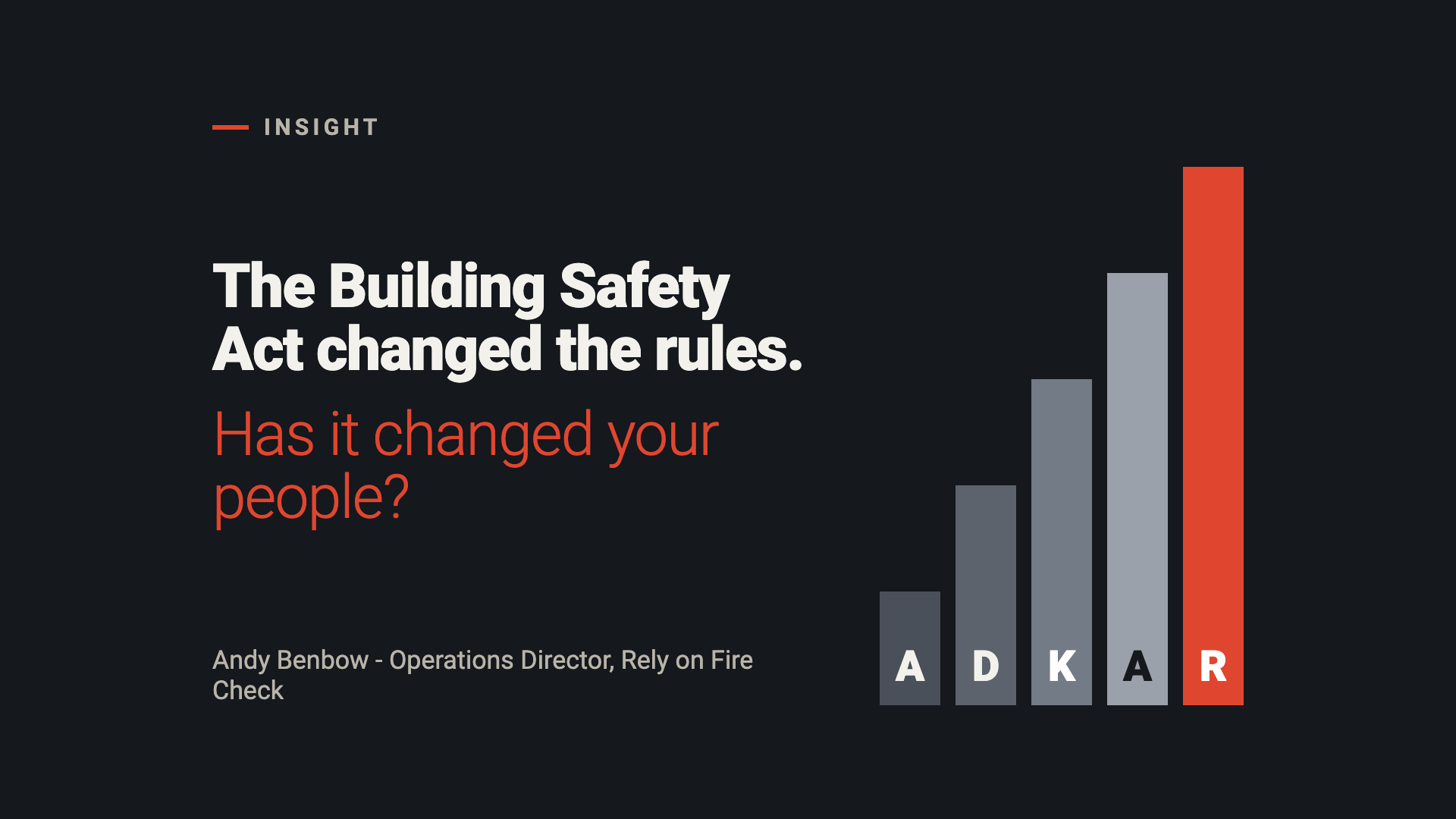
In this article, Andy Benbow, Operations Director at Rely on Fire Check, draws on his background in change management to explore why the Building Safety Act has not yet changed the culture of the built environment. He sets out how senior leaders can use the ADKAR model to bring their people through that change.
On many projects we work on, we still find the same things. Electrotechnical fire safety systems handed over with missing documentation. A supply chain that does not hold third-party certification and cannot evidence competence. Building management teams who hold a device schedule but don't know what records should sit behind it, or why.
These issues have been part of the industry for many years. Since the Building Safety Act, they carry far more weight. The Act has made accountability clearer, made the golden thread of information a legal expectation for higher-risk buildings, and made the consequences of getting it wrong potentially personal.
Yet on the ground, many of the old ways of working remain. The law has changed, but in many organisations the culture has not caught up.
Earlier in my career, before moving into fire safety, I spent a number of years in project and change management in the UK and New Zealand, working on infrastructure and technology programmes. Different sectors, but the same pattern: new systems, standards and processes only deliver when the people using them change how they work. The built environment is heading in the same direction, with more technology, more digital records and more scrutiny. The principles of behaviour and culture change are no different.
Treating the Act as a compliance exercise
Many organisations have responded to the Act by updating the paperwork. This usually means new policies, new job titles, new forms and a training session, then on to the next thing.
But a policy does not change behaviour. Change happens one person at a time, when each individual understands why they need to work differently and is willing and able to do so. If the people designing, installing, commissioning, maintaining and managing electrotechnical fire safety systems keep doing what they did before, the organisation has not changed, whatever its documents say.
This is where a structured approach to change, such as ADKAR, helps.
ADKAR in brief
ADKAR, developed by Prosci, is a model for individual change. It sets out five outcomes a person must achieve, in order, for change to stick:
- Awareness of the need for change
- Desire to take part in and support the change
- Knowledge of how to change
- Ability to put the change into practice
- Reinforcement to sustain it
The sequence matters. Each element builds on the one before. The first element where someone falls short is their barrier point, and that is where leaders need to focus. Pushing on the later steps achieves little until it is resolved.
ADKAR applied to electrotechnical fire safety system management
Awareness: why must things change?
Grenfell, and Dame Judith Hackitt's review that followed, exposed an industry where responsibility was unclear, information was lost and poor practice was tolerated. The Building Safety Act is the response.
For electrotechnical fire safety systems, the reality is that latent defects are often built in at design and installation, and routine servicing is not designed to find them. Many of these systems will be relied upon for decades, carrying those defects with them.
Announcing a new rule is not enough. Leaders need to explain why it matters. When the only reason given is that the regulation requires it, people do the minimum needed to show compliance on paper. When they understand what is at stake for the building, for the safety of the people in it, and for themselves, they change how they work.
Desire: why should I change?
Awareness does not guarantee buy-in. People need their own reason to change. For some it is personal accountability. For others it is professional pride, less rework, or knowing the system they signed off will protect the people in the building.
Leaders must also address resistance honestly. The objections we hear most are cost, programme pressure and the belief that this is just more paperwork. Those concerns are real, and ignoring them pushes resistance underground. Engage with them, and explain what the new way of working protects.
Knowledge: what do I need to know?
This is where most organisations start, and it is essential. Leaders need to make sure their teams understand the relevant British Standards and industry codes of practice, what competence looks like, what third-party certification actually evidences, and what records should exist for each system they are responsible for.
Knowledge also needs to be specific to the role. Generic awareness training does not tell anyone what to do differently on Monday morning. A designer needs to know what must be recorded and handed over. An installer or commissioning engineer needs to know what evidence proves the system was built and tested as designed. A maintainer needs to know what they are checking against. Building management teams need to know what documentation they should hold, and how to tell whether it is complete. Each role is a link in the golden thread, and each needs to understand its part in it.
Ability: can I actually do it?
This is the stage leaders most directly control. Knowing what to do is not the same as being able to do it. Ability depends on time, tools, workable processes and support. If an engineer knows a record is required but the programme leaves no time to produce it, the old behaviour will win.
Leaders create ability by resourcing the change properly. That means realistic programmes, clear processes, systems that make good records easy, and supervision and coaching while new habits form.
Reinforcement: will it stick?
Without reinforcement, people drift back to what they know. Reinforcement comes from audits and verification, from recognising people who do it right, from consequences when standards are not met, and from contracts and KPIs that reward the new way of working rather than the old.
The most common mistake: starting at Knowledge
The industry's default response to change is a training course. Training has its place, but it sits in the middle of the model, not at the start.
We regularly see teams that have been trained, know the standards and can describe what good looks like, but still cut corners. The gap is rarely knowledge. Usually nobody has made the case for change in a way that matters to them, or nothing in the organisation rewards doing it properly. Train a team that is stuck at Awareness or Desire and you get people who know the rules and carry on as before.
Work out where people are stuck before deciding what to do about it.
Where the structure works against change
Many of our clients rely on a principal contractors to deliver compliance. Inside many of those organisations, decisions flow from the top down. Commercial comes first, then operational, with the technical function at the bottom. The people who understand the standards and can see the problems are often the furthest from those steering the decisions. On a project running to tight margins and a fixed programme, their input or concerns can struggle to get a hearing.
On those projects, the targets that matter most are often profit and practical completion. A safe building is assumed to follow, but it is rarely what people are measured against, and behaviour follows what is measured.
Add to that a reluctance to raise problems for fear of being criticised, and issues get managed quietly instead of resolved. Change that depends on people speaking up does not last in that environment.
The same pattern appears well beyond construction. In estates and facilities teams, tight budgets, cost pressure and departments working in isolation create similar conditions. Responsibility for a fire safety system is split between people who rarely talk to each other, and nobody owns the whole picture.
In ADKAR terms, the technical people in these organisations often have the Awareness and the Knowledge. What they lack is a route for that knowledge to reach the people with the authority to act on it, and confidence that raising a problem will be welcomed. Only leaders can put those in place.
The role of senior leaders
Prosci's research consistently identifies active, visible sponsorship from senior leaders as one of the biggest contributors to successful change. In practice that means leaders who are seen to care, who ask questions and who hold themselves to the standard they expect of others.
Sponsorship works best when leaders have been through change themselves and understand what it asks of people. Leaders who have not can model the wrong behaviours and become the biggest obstacle to change. Holding on to familiar ways of working, doing what has always been done and wanting to control the narrative all suppress the change an organisation needs.
This is where the old culture is most persistent. The "just tell me everything is all right" mentality, from the boardroom down, drives the wrong behaviours. If the only answer leadership wants to hear is that everything is fine, that is the answer it will get, whether or not it is true. Problems stay hidden and the risk stays in the building.
The alternative, which Dame Judith Hackitt has urged on the industry since Grenfell, is to ask for an honest assessment. Where are we, where are the gaps, and what will it take to close them? Senior leaders who have the courage to ask those questions will get a very different answer, and in time a very different culture.
Line managers and supervisors carry change to the frontline. They need to be equipped to coach their teams as well as enforce standards. And senior leaders need to recognise that they are going through change themselves, with their own ADKAR journey to work through.
A quick self-assessment
Ask yourself these questions about your teams.
Awareness
- Can my people explain, in their own words, why the Building Safety Act changes how we work?
- Do they understand the consequences of defects in the systems we are responsible for?
Desire
- Do they see a personal reason to work differently?
- Have I heard and addressed their objections, or just overruled them?
Knowledge
- Do they know which standards apply and what records should exist for each system?
- Is their knowledge specific to their role?
Ability
- Do they have the time, tools and processes to do it properly?
- Is there support while new habits form?
- Can technical concerns reach the people who make decisions, without being filtered out by commercial pressure?
Reinforcement
- Do our audits, KPIs and contracts reward the new way of working?
- What happens when someone falls back into old habits?
The behaviours of the past belong in the past
The Building Safety Act set the direction. Culture will determine whether we get there.
There are encouraging signs that the industry is responding to the call for change. The most recent revision of the BAFE SP203-1 third-party certification scheme for fire detection and fire alarm systems now factors in the behaviours expected of a competent organisation and individuals, alongside skills, knowledge and experience. That means behaviour is becoming part of what organisations are assessed on.
Many of the ways of working that brought us here served the industry for years, but they are not what the Act now asks of us. For those accountable who want different results, the first step is a simple shift, from seeking reassurance that everything is all right, to asking for an honest picture of where things stand. From there, they can lead their people through the change that follows.
Start with one team or one process. Map it against ADKAR, find where people are stuck, and begin there.